
Friday, July 17, 2015

Tuesday, July 14, 2015
"Peace is every step"
Within the past few months, my emotional state has never been stable, calm or in control. I was either very excited by small events or got upset by everyday negligible problems. The feeling of "bipolar" emotion worried me even more, with occasional thoughts of not living at all. Since I am not able to control my thoughts and feelings, and that I could not make myself feel better, I didn't see anything sensual in life. Why would one go on living if she is to be unhappy in her mind, though her appearance doesn't betray any sign of misery?
Studying hard, I was trying to get to perfectly understand the core of subjects. The fact that I couldn't do that in certain classes made me feel even worse, causing me to blame myself for not being "smart enough". It felt like I was getting sucked down into an endless black-hole. Because of this thought, the feeling of being not "smart" made me even less effective, further strengthening the vicious cycle of negative thinking. Someone who once had a distaste in reading self-help articles was becoming one who always looked for answers to her unanswerable questions from the internet. It shouldn't go on this way.
But the quest for at least partial answers to my problems came with this book I found from google. A book about "peace of mind" or in current terms, "mindfulness". Thich Nhat Hanh, a zen buddhist monk whose activities for peace touched the lives of many, teaches mindfulness in his book, "Peace is every step: The path of mindfulness in everyday life". Peaceful state of mind can be attained with strong willingness to hang on to the present and be aware of what is happening in one's surrounding and one's own thoughts. A savvy to identify one's own emotional state, people's feeling, and focus to be able to recognize what is happening around oneself.
And the idea of meditating always fascinated me, though I wasn't persistent in it. Especially nowadays, with most urban people having hectic and busy lifestyle, "mindfulness" has been a big topic of interest for those who wanted to be able to focus better instead of losing oneself in endless stream of thoughts, negative thinking and mind of mess. What is mindfulness then?
 |
| Scheveningen, Buddha Statue |
Whenever I read or see someone giving advice on meditation, I could notice one common teaching of meditation: "Not trying to control your thoughts, but observing them, getting to recognize the patterns in them". Since my first trial of meditation ended up with me trying to not think about anything and block every thoughts out of my mind without any success, this approach seemed ironic. As time goes by, just letting go of control and stepping back to hear your thoughts came to be bit by bit more reasonable to me. Because, only by knowing your thinking, do I know myself. And only knowing myself, could I control or guide myself. It became clearer and clearer. Thus, I came to the conclusion that mindfulness starts from knowing yourself well.
Small book of modest expression, this book inspired me to be able to appreciate everyday simplicity. Being kind to others, not just to be liked by others, but to realize that you have the capacity to make others feel better about themselves is happiness in itself. A sense of self-worth. The capitalism that we have adopted in Mongolia is wrong because people have been convinced that it is a system where you have to fight for yourself even if it makes others worse-off.
Though this ideology might open doors to abundance of material wealth, in the deepest of human nature, it can never make people genuinely content in their lives. Because material greed is never satiated. Nonetheless, everyone can make the choice of what to look for in life: happiness or pleasure of mind and pleasure and greed for materials. The former might enable you to be satisfied in both dimensions but the latter will bring you only fancy junks.
Reading this book and repeating every chapters twice, helped me get myself grounded again. I started trying to anchor myself to the present with breathing, and take interest in what is happening around me. I also started identifying patterns in my negative thinking, while such thoughts once seemed like a new different kind of thoughts whenever I had them. Nevertheless, I realized that most of my negative thinking had specific repeating patterns. Fear of not being good enough, fear of not meeting the expectations of my family and low sense of self-worth.
Knowing this made me more in control and in touch with myself. And if anyone reached this end reading my writing, I would definitely recommend you the book of Thich Nhat Hanh. If you cannot find it, let me know and I can send you the e-book.
"... If I can ease one life the aching,
Or cool one pain,
Or help one fainting robin
Unto his nest again,
I shall not live in vain."
- Emily Dickinson
"... If I can ease one life the aching,
Or cool one pain,
Or help one fainting robin
Unto his nest again,
I shall not live in vain."
- Emily Dickinson
May this be the start of more peace of mind.
Best wishes,
Anuudari Burenbat,
2015.7.14
Tilburg University Library
Wednesday, June 10, 2015

Well well..
It's not that I am not totally sober on a Friday evening and I came to write
about some serious life stuff. I just had 5 times a 100 gr of wine. So I started with dancing alone to my
favorite songs (including "Taro" by Alt-J), continued with playing
Ukulele and ended up drawing a typography with my own absurd (well, it depends
from what perspective you see that) quotes. Enjoying every moments despite the
absurdity.
And
finally, I am here. Writing some spontaneous post on my blog.
So this
week, I decided to change my blog layout and title and URL etc.. I came to the
conclusion that the title "Weirdonomics" was too
"economical" which implied to me that the blog was not a personal
blog that reflects me not only as an economist, but as an individual who
has higher dimension than 1D, only profession. Actually first I decided to
start the blog to write everything that I found interesting in economics or
worth telling about it. But now, I am feeling restricted by the title... Well.
Silly, I know.
And in
two months, I will be graduating with a degree of MSc in
Econometrics from Tilburg University in the Netherlands, which is vigorously emerging to the world market of higher
education. Thanks to a man who is kind-hearted and conversational at my
previous internship, I've been informed about Tilburg University. There were
times, when it became hard to bear. But I can promise "just blindly
knowing" everything is gonna be better is pretty helpful. The key is to
not stop at those times, I guess.
 |
| Tulip Mania: 1640 by Jan Brueghel the Younger |
The reason of many disappointment with myself is the hard-working nature of the students. Since the first day at Tilburg University, I
was impressed and overwhelmed about the responsibility and willingness to learn of the international
students. Probably it is not just because they are international students, but
maybe it was because they have been admitted to a university ranking in top 5
in EU and top 40 throughout the world in terms of economics and business
studies.
Furthermore,
the Dutch people are hard-working and career is an important part of their
lives, to live happy and satisfied. They prove that you can keep up both career
and family lives well by using
them as vitality that sustain one another. If
you are good at your work, you can have a good money and can spend time with family
doing cool things. If you are a member of a happy family, you will have energy
and optimism for working harder.
They can also really create a warm atmosphere among themselves. They can work hard without excluding life's simple pleasures with friends and family. During warm weather on every Friday evening on my way back home, I would see an extended family having dinner, talking and laughing with one another without age limits.
Econometrics
was supposedly the most challenging program at the university with large share
of the students as locals. It usually took me long to grasp an idea or complete
an assignment. At times, I got demotivated to study due to the complexities of
the courses that I would watch IMDB high rated films instead of studying. And
they were actually helpful since I delved back to studying with renewed
mindset.
Nevertheless of all "not so well" times, student life was experienced, since I had crazy moments of youthfulness here. Student life is characterized as studying desperately, having fun with dare with that tendency to do anything. Plus, a year away from home reveals how valuable the people you have back home. I felt 'rationally' how the people I have in my life were important.
Within the year in the Netherlands, I missed home and there were lot of times that I just wanted to be hugged and reassured that I am capable to keep on continuing. And now I still do. But it is somehow different.
Best
wishes,
Anuudari
Burenbat
Midnight,
2015.6.5
Tuesday, June 9, 2015
Лемоны зах зээл хүмүүсийн дунд.
Ижилхэн төрлийн машиний хоёр зах зээл зэрэгцэн оршиж байв. Зарагдаж буй машины чанар хоорондоо тэс ондоо ч гэсэн харахад ялгаагүй. Худалдан авагчид бас хэн сайн, хэн муу машин зарж байгааг мэдэхгүй. Энэ зах зээл яах бол? Хэрвээ дунд түвшний микро эдийн засаг хичээлийг судалсан бол энэхүү Лемоны зах зээлд юу болохыг гадарлаж байгаа байх. Логикоороо хөөж бодож ч болно...
Юу болох вэ? 1970 онд Жорж Акерлоф "The Market for Lemons: Quality Uncertainty and the Market Mechanism" ажлаараа мэдээллийн тэгш бус байдлын эдийн засаг дахь нөлөөллийг эдийн засгийн томъёоллоор тодорхойлсон. Энэ чиглэлийн судалгаагаар Ж.Стиглиц, М.Спенс нарын хамт Нобелийн шагнал хүртсэн юм. (Сониноос Акерлоф Холбооны Нөөцийн Банкны эмэгтэй ерөнхийлөгч Жанет Иеллэний эр нөхөр шүү дээ :)
Лемоны зах зээл дээрх машины наймаачид үнэн чанар нь ямар байхаас үл хамааран худалдан авагчдад бараагаа сайн чанартай л гэж сурталчилдаг. Бүгд "сайн чанарын" бараа болохоос хойш үнэ нь ч чанаргүй бараанаас үнэтэй тогтоно. Гэвч хугацаа өнгөрөх тусам энэ сайн муу хосолсон нууцлагдмал зах зээлээс муу чанарын барааг илүү үнээр авсан худалдан авагчид ундуйцаж, бусдад зарлаж эхлэнэ. Ингээд тухайн зах зээл дээрхи хүлээлт буурснаас эрэлт бүтнээрээ унах болно.
Энэ үйл явц чанартай бараа зардаг "үнэнч" худалдагчдын сайн наймаа хийх хөшүүргийг бууруулж, бүх барааны чанар ерөнхийдөө муу болоход хүргэх ба эцэст нь энэ зах зээл сүйрэх дээр ирнэ.
Энэхүү "market failure" хүмүүсийн дунд ч, тэр тусмаа хөдөлмөрийн зах зээл дээр дөнгөж хөл тавьж буй залуучуудад тохиолдож болно.
Хэрвээ та "лемоны" зах зээл дээр сайн муу чанартай 2 төрлийн машин оршиж байгаад эдийн засгийн хөшүүрэг буурснаас болж зах зээл тэр чигээрээ муу машин худалддаг болсныг ойлгосон бол залуучуудын дунд юу болохыг бас таамагласан байх!
Чин сэтгэлээсээ хөдөлмөрлөж, сурах чухал гэдгийг мэддэг залуучууд цөөнхи үед "тэднээс ондоо" хэсэг бүлэг залуус яг тэдэн шиг мэдлэг чадвартай, өөртөө итгэлтэй загнаж, дүр үзүүлж чадах болно. Ажил олгогчид, сурган хүмүүжүүлэгчид тэдний толгойд юу байгааг харж чадахгүй, хэн нь өөртөө үнэнч гэдгийг мэдэхгүй, ялгахгүй.
Энэ хандлага "сайн" залуусын урмыг хугалж, "муу" байсан ч болох л юм шиг байна гэсэн бодол төрүүлнэ. Энэ бодол тэдний үйл хөдлөлөөр илэрч эхэлмэгц тэр хөдөлмөрийн зах зээлийн чанар уруудаж эхлэх. Уруудахдаа цаст уулаас өнхөрж буй бөмбөлөг мэт уруудах тусмаа хурдалж, чанар тэр их хэмжээгээр унасаар...
Арай гутранги логик байна л даа...
Гэхдээ хааяахан,.. заримдаа л.. нэлээд удаа... би үүнтэй төстэй зүйлийг үеийнхээ залуучуудаас хардаг. Биенээ нэг зүйлд сэтгэл шулуудан зүтгэж байхад нь эргэлзлийн харанхуй руу үгээрээ түлхэж орхидог хүмүүс байдаг. Өөрсдөө тэгэж чадахгүй эсвэл залхуурсан болоод тэр. Тэр үгийг сонссон залуу өөрийн хичээл зүтгэлдээ эргэлзэж эхэлснээр түүний "чанар" муудаж эхлэнэ...
Эдийн засгийн онолоос гарсан Лемоны проблем энэ тохиолдолд хүний сэтгэл хөдлөлөөр илэрч байна. Урам хугарал, эргэлзээ, гутрал, айдас... Зүтгэж байгаа хүний өмнө садаа болох үг толгойд чинь орвол тэр үгээ залги. Эсвэл өөрөөсөө би юунд ингэж зүтгэл гаргаж байлаа гээд нэг асуу! Гол нь тэр хүний итгэлийг битгий хумсал. Зүгээр л орхи.
Бүрэнбатын Ануударь,
Тилбургийн Их Сургуулийн номын сангаас,
2015.6.9
Note: Abruptly had the idea of the Lemmon's problem in labor market. For no one in particular.
 |
| Лемон |
Энэхүү "market failure" хүмүүсийн дунд ч, тэр тусмаа хөдөлмөрийн зах зээл дээр дөнгөж хөл тавьж буй залуучуудад тохиолдож болно.
Хэрвээ та "лемоны" зах зээл дээр сайн муу чанартай 2 төрлийн машин оршиж байгаад эдийн засгийн хөшүүрэг буурснаас болж зах зээл тэр чигээрээ муу машин худалддаг болсныг ойлгосон бол залуучуудын дунд юу болохыг бас таамагласан байх!
Чин сэтгэлээсээ хөдөлмөрлөж, сурах чухал гэдгийг мэддэг залуучууд цөөнхи үед "тэднээс ондоо" хэсэг бүлэг залуус яг тэдэн шиг мэдлэг чадвартай, өөртөө итгэлтэй загнаж, дүр үзүүлж чадах болно. Ажил олгогчид, сурган хүмүүжүүлэгчид тэдний толгойд юу байгааг харж чадахгүй, хэн нь өөртөө үнэнч гэдгийг мэдэхгүй, ялгахгүй.
Энэ хандлага "сайн" залуусын урмыг хугалж, "муу" байсан ч болох л юм шиг байна гэсэн бодол төрүүлнэ. Энэ бодол тэдний үйл хөдлөлөөр илэрч эхэлмэгц тэр хөдөлмөрийн зах зээлийн чанар уруудаж эхлэх. Уруудахдаа цаст уулаас өнхөрж буй бөмбөлөг мэт уруудах тусмаа хурдалж, чанар тэр их хэмжээгээр унасаар...
Арай гутранги логик байна л даа...
Гэхдээ хааяахан,.. заримдаа л.. нэлээд удаа... би үүнтэй төстэй зүйлийг үеийнхээ залуучуудаас хардаг. Биенээ нэг зүйлд сэтгэл шулуудан зүтгэж байхад нь эргэлзлийн харанхуй руу үгээрээ түлхэж орхидог хүмүүс байдаг. Өөрсдөө тэгэж чадахгүй эсвэл залхуурсан болоод тэр. Тэр үгийг сонссон залуу өөрийн хичээл зүтгэлдээ эргэлзэж эхэлснээр түүний "чанар" муудаж эхлэнэ...
Эдийн засгийн онолоос гарсан Лемоны проблем энэ тохиолдолд хүний сэтгэл хөдлөлөөр илэрч байна. Урам хугарал, эргэлзээ, гутрал, айдас... Зүтгэж байгаа хүний өмнө садаа болох үг толгойд чинь орвол тэр үгээ залги. Эсвэл өөрөөсөө би юунд ингэж зүтгэл гаргаж байлаа гээд нэг асуу! Гол нь тэр хүний итгэлийг битгий хумсал. Зүгээр л орхи.
Бүрэнбатын Ануударь,
Тилбургийн Их Сургуулийн номын сангаас,
2015.6.9
Note: Abruptly had the idea of the Lemmon's problem in labor market. For no one in particular.
Saturday, March 7, 2015
Simple view of inequality from consumer surplus perspective
While studying for a seminar in International Competitiveness course at TiU, I encountered with this idea on inequality. As far as my knowledge in economics is concerned, I have never learned about inequality from this "new" perspective. In Microeconomics I, all students who studied economics and business should have learned about partial equilibrium in a market. When price and quantity is set in equilibrium, there is producer and consumer surplus.
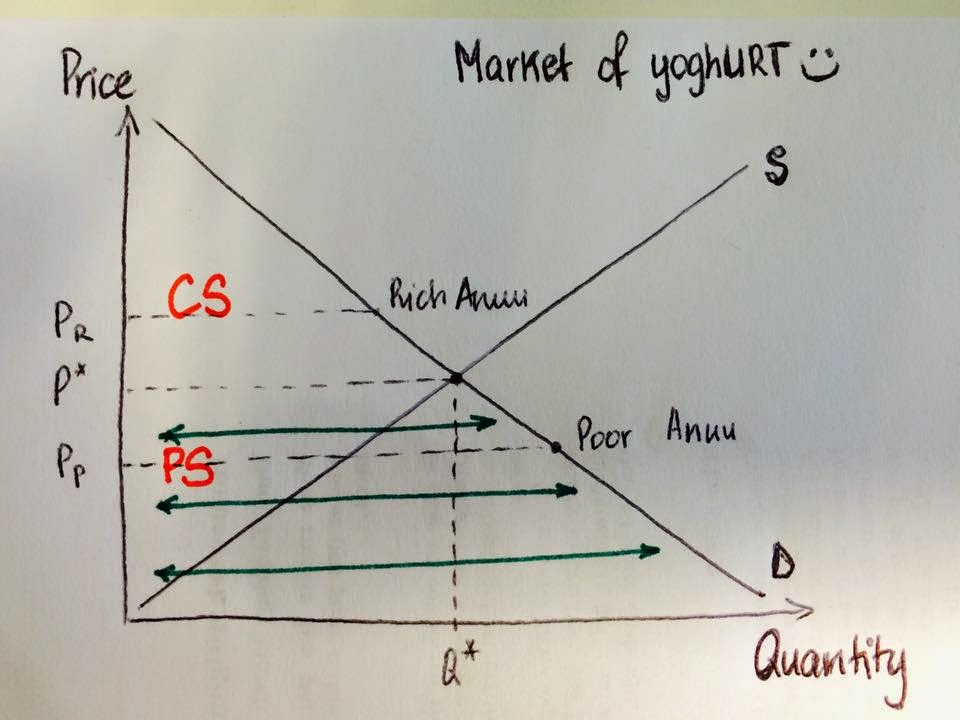 Consumer surplus is expressed as the value of demand satisfied at lower price than was expected if equilibrium was not reached. But, notice that the equilibrium price does not allow consumers with lower willingness-to-pay to consume the goods. Thus, people who are not able to pay the price does not benefit from perfect market equilibrium. Of course, since the analysis is pretty general, people with lower willingness to pay might not be the poor, but just the people who does not value the good as much. However, the idea was a very simple aspect of explaining inequality.
People who can not afford the good and they have no surplus at all from this market. The poor will always have low willingness-to-pay, so they will have the least surplus in most of markets. Serious economists might think it is a good humor in its simplicity, but I really like this generalization of microeconomic theory to inequality :)
/Market of yogurt: As shown above, the equilibrium price will not allow me to have my favorite food if my demand evaluation is P_p while I can have consume more if it is P_r at the equilibrium price P*/ :))
Берлин гурван үеийн түүхийг өгүүлэхүй
Гурван өдөрт үзэж амжихгүй олон түүхэн газар, парк, хөшөө дурсгалуудтай энэ хот хүн амаараа Монгол улсаас хагас саяар илүү. Европын хамгийн хүчирхэг улсын нийслэл, дэлхийн хэмжээний том хотоос гадна дэлхийн түүхийн ул мөр тод үлдсэн газар.
Хуучны тансаг барилга, социализмын саарал дөрвөлжин сууцууд, орчин үеийн шилэн ордууд хосолсон Фридрихийн гудамж. Гоёмсог хээ угалз бүхий архитектур, Грек стилийн гантиг хөшөөнүүд, сүрлэг том сүм, доомууд, нэгэн хэвийн бүрсгэр гудмууд, дэлхийн хувцас загварын брэнд дэлгүүрүүд эгнэх модерн барилгууд бүгд... энд бий. Үүгээр алхахад нэг зүйл бодогдсон: дэлхийн түүхийн гурван чухал эрин Берлин хотын өнгө төрхөөс харагддаг юм байна гэж. Энэхүү тэмдэглэлдээ энэ гурван үеийг гурван дурсгалт газраар баяжуулан бичлээ.
I. Берлиний Дом
Ромын эзэнт гүрний хүчирхэг омог байсан Герман үндэстнүүд (Germanics) дундад зуунд баруун Европд хүчээ авч, шашин, соёлын өв эндээс л ундарч байв. Ард түмний дунд шашин шүтлэг дэлгэрхийн зэрэгцээ сүмийн эрх мэдэл хүрээгээ тэлж, "нүгэлтэй баячууд"-н өөрийгөө цагаатгах гэсэн мөнгөөр санваартнууд элитийн байр сууринд очоод байлаа.
Харин Германчуудын дундаас Христийн номлолыг эгэл ард түмэн, ядууст хүртээлтэй, хүн бүрт мөнгөөр бус сэтгэлээр үйлчлэх сүм байгуулах санаа гарсан нь Протестант хувьсгалыг эхлүүлсэн байна. Энэ бол бидний Доктор Кингтэй андуурч ойлгодог ширээт лам Мартин Лютер юм. Тэрээр баячуудын нүглийг ариусгаж оронд нь мөнгө авах христийн номлогчдын үйл ажиллагаанд илт дургүйцэж байв. Энэ дургүйцлээ тэр зөвхөн санваартнуудын ойлгож уншдаг байсан Библийг өөрийн хэлнээ буулгаж баян ядууг үл харгалзан хүн бүрт унших боломжийг нээж өгснөөрөө илэрхийлсэн юм.
Гэвч хуучинсаг Католикчуудын эсэргүүцэл үндэстний хагарал бий болгож, газар нутаг, ард түмэн ч хуваагджээ. Хэдийгээр шашны хагарал 30 жилийн дайныг өдөөж Германчууд гурав хуваагдан хүч тарсан боловч тэдний нэг Пруссын эзэнт гүрэн хүчирхэг хэвээр л байсан байна. Берлиний төв дүүрэг Миттед байрлах энэхүү Доом Мартин Лютерийн авчирсан Протестант хувьсгалын түүхийг өгүүлдэг. Зөвхөн нийгмийн түүхийг бус сүрлэг хийцээрээ урлагийн түүхийг ч гайхалтайгаар харуулна. Берлинд очвол ийшээ заавал очоорой. Одоогоор миний зочилсон хамгийн гайхамшигтай Христийн сүм.
II. Берлиний хана
Аж үйлдвэрийн хувьсгал 17-18 зуунд эхэлснээр эдийн засаг нь хөл дээрээ босч, Берлин хот цэцэглэв. Энэ үеэр эдийн засгаа хүчирхэгжүүлж, хурдацтай хөгжиж байсан шинжлэх ухааны их сургуулиуд, урлаг, нийгмийн ухааны томоохон төв болоод байв. Берлинд үлдсэн дурсгалт газруудаас энэ хот социализмын хүнд хэлбэр Коммунизм, цаашлаад хэрцгийрсэн, Фашизмын цэг "байсныг" харж болно. Хамгийн том жишээ Берлиний хана.
19-р зууны сүүлээр Коммунизмын "саарал" сүүдэр тусч, Марксын номлол цуурайтаж эхэлж байв. Гэвч энэ номлол аж үйлдвэрлэлийн завгүй өрнөлд халхлагдаж, хамгийн хүчирхэг эдийн засгийн нэг болсон байлаа. Харамсалтай нь 1923 оноос дэлхий дахиныг шуугиулсан Их Хямрал Германыг тойрж бус дайрж өнгөрсөн нь улс төрийн тогтворгүй байдал, эдийн засгийн уналтад хүргэж, хэдхэн жилийн дараа энэхүү аж үйлдвэржсэн улсад Нацист дэглэм тогтлоо.

Нацизмын уналтын дараа Герман улс зүүн, баруун 2 хэсэгт хуваагдсан. Зүүн Герман социалист дэглэм авч үлдсэн бол Баруун Герман Америкийн капитализмыг даган хөгжсөн. Баруун Герман эдийн засгийн цэцэглэл, эрх чөлөөний орон болж байснаас Зүүний иргэд тийш нүүж эхэлснээр ]жилийн дотор хүн амых нь дөрөвний нэг нь нүүж эдийн засгийн тогтворгүй байдал үүсээд байлаа. Үүнийг хязгаарлах гэж Берлин хотод зүүн барууныг тусгааралсан ханыг барьсан байна. Хананы туурь дээр Баруун руу дөрвөх гэж оролдоод амиа алдсан 136 хүний хөрөгт хүндэтгэлийн дурсгал босгожээ.
1989 онд Америкийн нөлөөгөөр Берлиний ханыг нураасан нь Капитализмын эхлэл болов. Үйлдвэрлэл төрөлжиж, шинэлэг улс төрийн тогтолцоо найдвар тээн АНУ-н хөрөнгөтний дэглэмийг даган эрчимтэй хөгжлийн замд дахин орсон байна. Харин одоо энэ хот ихээхэн даяаршсан капиталист нийслэл болохыг хөл ихтэй томоо худалдааны гудамж, олон үндэстний бүрэлдэхүүнээс нь илэрхий.
Баруун, зүүн Берлиний хил байсан Фридрихийн гудмаас зүүн урд зүгт алхвал Спрээ гол урсахыг харна. Голын дагуу цаашилвал Митте дүүрэгт нэгэн арал бий. Олон улсын хэмжээний таван музей энд байрлах ба 1999 онд НҮБ-ын Дэлхийн соёлын өв болгосон байдаг. Миттегийн арлыг Музейн арал хэмээн нэрлэсний учир энэ юм.
 |
| Berliner Dom |
 |
| River Spree |
 |
| Berliner Dom with my candle creature |
I. Берлиний Дом
Ромын эзэнт гүрний хүчирхэг омог байсан Герман үндэстнүүд (Germanics) дундад зуунд баруун Европд хүчээ авч, шашин, соёлын өв эндээс л ундарч байв. Ард түмний дунд шашин шүтлэг дэлгэрхийн зэрэгцээ сүмийн эрх мэдэл хүрээгээ тэлж, "нүгэлтэй баячууд"-н өөрийгөө цагаатгах гэсэн мөнгөөр санваартнууд элитийн байр сууринд очоод байлаа.
 |
| Dome from the inside |
 |
| Parliament of Germany Bundestag |
Харин Германчуудын дундаас Христийн номлолыг эгэл ард түмэн, ядууст хүртээлтэй, хүн бүрт мөнгөөр бус сэтгэлээр үйлчлэх сүм байгуулах санаа гарсан нь Протестант хувьсгалыг эхлүүлсэн байна. Энэ бол бидний Доктор Кингтэй андуурч ойлгодог ширээт лам Мартин Лютер юм. Тэрээр баячуудын нүглийг ариусгаж оронд нь мөнгө авах христийн номлогчдын үйл ажиллагаанд илт дургүйцэж байв. Энэ дургүйцлээ тэр зөвхөн санваартнуудын ойлгож уншдаг байсан Библийг өөрийн хэлнээ буулгаж баян ядууг үл харгалзан хүн бүрт унших боломжийг нээж өгснөөрөө илэрхийлсэн юм.
 |
| History Museum of Berlin |
Гэвч хуучинсаг Католикчуудын эсэргүүцэл үндэстний хагарал бий болгож, газар нутаг, ард түмэн ч хуваагджээ. Хэдийгээр шашны хагарал 30 жилийн дайныг өдөөж Германчууд гурав хуваагдан хүч тарсан боловч тэдний нэг Пруссын эзэнт гүрэн хүчирхэг хэвээр л байсан байна. Берлиний төв дүүрэг Миттед байрлах энэхүү Доом Мартин Лютерийн авчирсан Протестант хувьсгалын түүхийг өгүүлдэг. Зөвхөн нийгмийн түүхийг бус сүрлэг хийцээрээ урлагийн түүхийг ч гайхалтайгаар харуулна. Берлинд очвол ийшээ заавал очоорой. Одоогоор миний зочилсон хамгийн гайхамшигтай Христийн сүм.
II. Берлиний хана
Аж үйлдвэрийн хувьсгал 17-18 зуунд эхэлснээр эдийн засаг нь хөл дээрээ босч, Берлин хот цэцэглэв. Энэ үеэр эдийн засгаа хүчирхэгжүүлж, хурдацтай хөгжиж байсан шинжлэх ухааны их сургуулиуд, урлаг, нийгмийн ухааны томоохон төв болоод байв. Берлинд үлдсэн дурсгалт газруудаас энэ хот социализмын хүнд хэлбэр Коммунизм, цаашлаад хэрцгийрсэн, Фашизмын цэг "байсныг" харж болно. Хамгийн том жишээ Берлиний хана.
 |
| Remains of the wall |
 |
| Memorial for 136 victims of the Wall |
Нацизмын уналтын дараа Герман улс зүүн, баруун 2 хэсэгт хуваагдсан. Зүүн Герман социалист дэглэм авч үлдсэн бол Баруун Герман Америкийн капитализмыг даган хөгжсөн. Баруун Герман эдийн засгийн цэцэглэл, эрх чөлөөний орон болж байснаас Зүүний иргэд тийш нүүж эхэлснээр ]жилийн дотор хүн амых нь дөрөвний нэг нь нүүж эдийн засгийн тогтворгүй байдал үүсээд байлаа. Үүнийг хязгаарлах гэж Берлин хотод зүүн барууныг тусгааралсан ханыг барьсан байна. Хананы туурь дээр Баруун руу дөрвөх гэж оролдоод амиа алдсан 136 хүний хөрөгт хүндэтгэлийн дурсгал босгожээ.
III. Митте гудамжинд англиар...
 |
| Sunset in Mitte |
 |
| Twilight in Mitte |

Баруун, зүүн Берлиний хил байсан Фридрихийн гудмаас зүүн урд зүгт алхвал Спрээ гол урсахыг харна. Голын дагуу цаашилвал Митте дүүрэгт нэгэн арал бий. Олон улсын хэмжээний таван музей энд байрлах ба 1999 онд НҮБ-ын Дэлхийн соёлын өв болгосон байдаг. Миттегийн арлыг Музейн арал хэмээн нэрлэсний учир энэ юм.
Өөрийн өссөн орчноос гарч, дэлхийн соёлын өв болсон газруудаар явах нь аялал хийсэндээ биш хүн юу хийж бүтээх чадвартай болохыг харж чаддаг нь хамгийн том сургамж болдог бол уу.

Бүрэнбатын Ануударь
2014.12.28
Subscribe to:
Posts (Atom)